

Is AI becoming our idol? "We seek answers from the machine instead of asking God"
What happened
Agata Rusek cited Augustine of Hippo.
- Who
- Agata RusekPoland
- To whom
- Augustine of HippoAugustinian Order
- Kind of action
- Said or cited
- Tone
- Mixed
- When
- Nov 13, 2026
- Reported by
- Magdalena Urbańska, Agata Rusek, Deon.pl
Every action it reports: 5
- Agata Rusek cited Augustine of HippoSaid or cited
- Agata Rusek cited Habakkuk 2:19Said or cited
- Agata Rusek warned about ChatGPTSaid or cited
- Magda Urbańska cited Pope FrancisSaid or cited
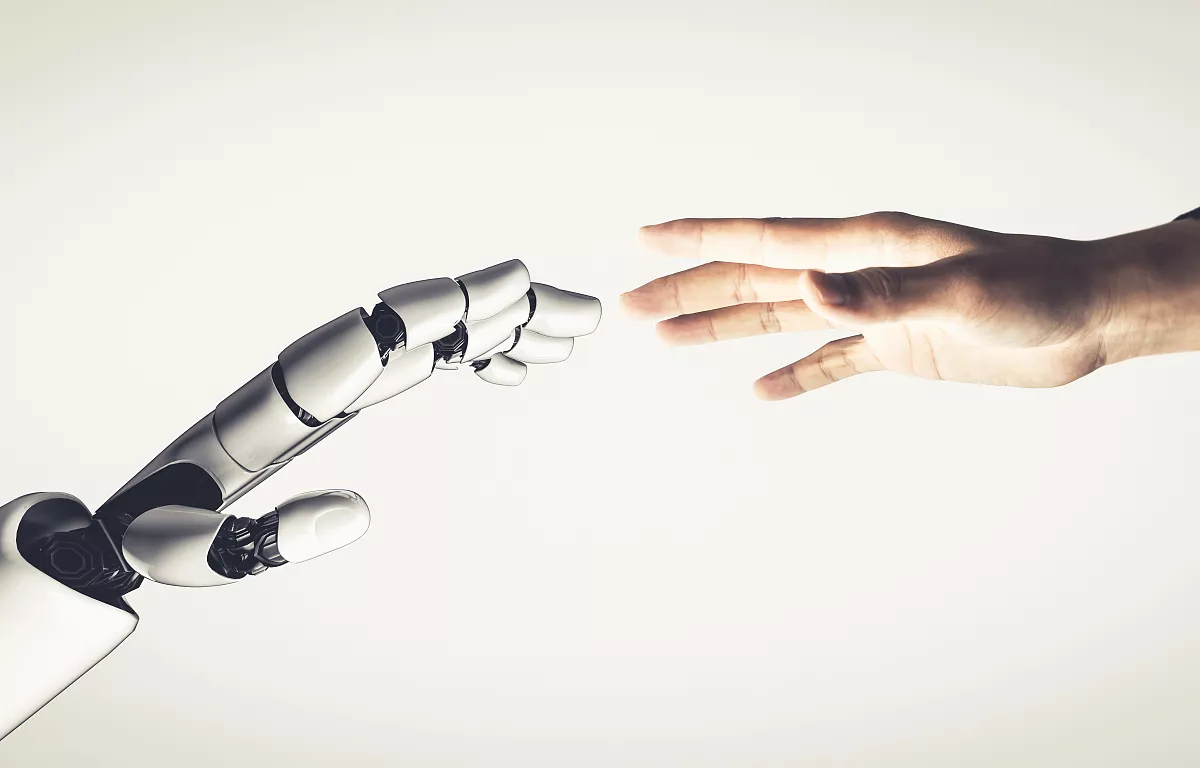
Is AI Becoming Our Idol? "We Seek Answers from a Machine Instead of Asking God"
Do I believe God is greater than AI? Let's talk about fears, convictions, and the influence technology has on our image of the Lord God.
Agata Rusek: Madziu, I have to admit this topic seems extremely important to me, and at the same time completely passed over in silence among us. I glance at my phone feed and in a single moment I learn that, on the one hand, AI will cure cancer, clean up the planet, and free us from the need to work, but on the other, that same AI will take away the meaning of existence, dismantle democracy, and probably wipe out the species. The heads of the four largest American artificial intelligence companies don't make my life any easier, because almost every day they cross some new barrier, and there are no shortages of people who call them modern prophets or saviors, since any moment now their AI will become a perfect self-awareness that will solve all of humanity's problems.
Yet I cannot shake the impression that when some declare their invention will save the world, and others that it will destroy it, both versions amount to saying the product is omnipotent. And omnipotence, setting aside fictional pop-culture superheroes, is a quality quite strictly reserved for the Lord God, at least as we profess it in the Creed. So I wonder whether some fundamental doubt, or even a creeping heresy, isn't slipping in through the back door among us believers...
Pope Francis, in one of his catecheses on the Decalogue, explained that "an idol is whatever rules over us, captures our heart, and becomes the axis of our life," and perhaps that is exactly the point, because an idol can very easily be seated on the throne in the heart, provided we think about it often enough...
Magda Urbańska: Agatka, what you say, that "provided we think about it often enough," is for me a key thought here, you know? I don't follow closely what happens on the technology market, but I see how insistently technology pushes into every area of life. I see how relationships grow poorer, how easily it stirs in us a desire to possess, panicked fear, or disorientation.
Still, my life unfolds in the real world: at home, at work, in the parish... Perhaps that is exactly why I wouldn't call technology my idol, because I spend most of my time disconnected from the network [laughter]. But I know this isn't so obvious, and it is becoming less and less common...
And I know how I myself get caught in the net. Sometimes very literally.
Agata Rusek: Yes, certainly the perspective of someone who works in the digital industry and reads about the revolution in human history day after day is entirely different [laughter]. But I must tell you that whenever, again and again, in very different circles, from parents in the school corridor, through friends at church, to young people I meet with professionally, I hear remarks like "Ejaj knows the answer to every question, Ejaj will help me, Ejaj will do something for me," the association with an idol strikes me strongly. Especially when I read the Old Testament.
There, where the psalmist mocks idols that "have mouths but do not speak," or, like Habakkuk, cries out: "Woe to him who says to wood, 'Wake up!' to silent stone, 'Rouse yourself!' Can it give direction? It is overlaid with gold and silver, yet there is no breath of life in it at all" (Hab 2:19).
I read this and think that our computers have indeed seemed to wake up today, they give directions in fluent Polish and are clad in glass and aluminum, yet the end of this verse remains accurate to the letter: they still have no spirit. But do we really see this? In this context I think it is very easy to miss that the Lord God is not "greater" than AI, because He cannot be measured by any standard at all!
He cannot be compared to anything or anyone. When we think about it, His greatness has truly, let's admit, very strange dimensions, since it fit into a manger, into a piece of bread, and into a man nailed to the cross, and at the same time He is beyond time, beyond all frameworks, giving principles and rules that exceed all human knowing. And yet so many, including us believers, will sooner ask AI for advice than ask the Lord God in prayer [laughter through tears].
Magda Urbańska: I agree with what you say, that "Ejaj" is often the first thought when a problem or question arises... Lately I've been wondering why this is so, where this reflex comes from, often unconditional. Perhaps because you touch the phone, but not God?
I think we easily let ourselves be caught by this. By the fact that the virtual world often seems closer to us, because it is easier to embrace with reason and senses, though in truth only seemingly. No one of us has yet seen God face to face.
Answers in a GPT chat, yes. And they are clear, immediate, available at any moment. In silence and in noise.
This is what misleads us. It gives the illusion of closeness that technology cannot truly give us, but a relationship with God can. Only this is for me a much deeper topic, you know?
What are my experiences of faith and relationship? What convictions do I carry within me about God, His goodness, omnipotence, and love? We long for closeness, and we feed on its crumbs...
Believing that deep needs, which, let's be honest, require a great deal of effort on our part, can be satisfied quickly and easily.
Agata Rusek: What stopped me was your question about the convictions we carry within us regarding God, because I have the impression that nothing exposes them as effectively as fear. Do you know that feeling, when the children are already in bed, you look at their sleeping little faces and feel your stomach tighten, because a film titled "what kind of world will they live in" starts playing in your head? I often catch myself finding it easy to believe in God's Providence over what I know and can somehow grasp with reason: over our home, the children's school, the health of our loved ones.
It is much harder for me to believe that the Lord also reigns over that future which escapes my imagination. It's as if I were quietly assuming that His power ends roughly where my understanding of the world ends. Lately I've been wondering whether we have become a generation that fears the technological end of the world more than the loss of a relationship with God.
I remember December 1999 and adults who seriously considered whether, at midnight, the Millennium Bug would switch everything off, from cash machines to power plants... Our parents grew up in the shadow of the atomic bomb, so perhaps every generation has its apocalypse in a technological version [laughs]... Soon we will be calling out "Marana tha," that is, "Come, Lord."
And I think to myself: I wonder which end of the world seems more real to us, the one prepared for us by AI, which will slip out of its creators' control, or the one planned by the Lord.
Magda Urbańska: You know, I keep having the feeling that many people don't really stop to think about this at all… We're a society oriented toward consumption, not reflection… The war abroad jolts us a little, along with the thought: what if they cut the power?
Then everything stops, and that stirs a kind of panic, because most of our everyday affairs need electricity and internet access.
On the other hand, I sense that deep down we still carry the conviction that God is and will be. We value what we stand to lose… And I think it's often the case that we don't think about our relationship with Jesus in this way.
We fear being cut off from technology, but less so from God, because we know, perhaps subconsciously, that He cannot easily be cut off from us by external factors. Perhaps that's because, as human beings, we have a deep longing for relationship, even if we aren't aware of it. The trouble is that in this whole technological bubble we have begun to lose sight of where those relationships are truly life-giving…
Agata Rusek: We were created for relationship, so everywhere we look for some "You." We make out faces in clouds and in electrical outlets, and all the more in something that answers us in fluent Polish, patiently, without judgment, at any hour of the day or night. St. Augustine wrote that our hearts are restless until they rest in God, and I feel that this holy restlessness is very easily redirected today onto a screen that only pretends to listen to us.
Look at how many problems we bring to internet search engines. Of course most people ask about practical matters, but there have already been projects where a "digital priest" appeared, with whom you could talk about matters of faith or life dilemmas! And people asked about things that one discerns sometimes over years, not settles in a conversation with an avatar.
Don't you sometimes feel that it is easier today to ask a question of a machine than of one's own heart?
Magda Urbańska: Yes, I know many practicing Catholics who don't ask their conscience but ChatGPT. When a moral problem arises, they talk to the chatbot, not to the priest in the confessional. From my perspective, it simply looks like this: the chatbot has never let us down, but a person has.
The AI always answers politely, while a person doesn't always smile at us, is in a hurry, or doesn't reply to messages for several days. And the sense of shame is smaller when we don't look another person in the eye. Over time, however, it turns out that something is still missing, that the online creation is only an empty shell, because yes, it gives an answer, but it can't give that sense of deep relief, like after a conversation with a friend that lifts a weight off your back.
Not to mention the feeling right after confession, which no internet connection can replace...
Agata Rusek: A rather provocative image also comes to mind in this context: it's easy to treat the algorithm today as a kind of digital Holy Spirit. Very often it is precisely to it that we turn for hints, inspirations, insights, knowledge, advice, courage… In theory it's easy to recognize the difference.
The algorithm has one overriding goal: it wants to hold me in place, to capture my attention. So it feeds me whatever will stop me, most often sensation, outrage, or fear, because those are what we react to fastest, and we stare at the screen, and stare, and stare. The Holy Spirit in the Upper Room did exactly the opposite: He drove the frightened apostles out of the locked room into the streets of Jerusalem.
To people. We can also look at St. Paul and ask whether the algorithm's activity yields in me the fruits of the Spirit: love, joy, peace, patience, kindness, goodness, faithfulness, gentleness, and self-control. When, after forty minutes of scrolling, I do a quick tally of what has remained in me, I usually come up with fruits of a completely different kind: irritation, dissatisfaction, envy, and a strange, diffuse unease [laughing through tears].
So in theory it's easy to recognize that technology is a poor addressee for articulating our needs and the desires of our hearts, but in practice, I feel, we very easily place our faith and trust there.
Magda Urbańska: I'm old, so I may repeat myself [laughs], but for me this is exactly the taking of the easy way out. It's a scrap we fill ourselves with when we fear that real relationships won't nourish us, so why go out to people at all. Yet it is as you say: God encourages us toward relationship.
We grow in them, not in contact with an avatar. I have a very strong and telling experience from the last few weeks. For several years I worked remotely, from home.
My relationships with colleagues took place mainly through messaging apps; we rarely met in person because we're scattered all over Poland. When I started working at a school in September, I wondered how I would fit in. I knew I would have to learn to build relationships anew.
Now my colleagues, the school principal, and above all my students may want to chat, hug, or ask something at any moment. I'm constantly in view, constantly in contact with people. And although I love quiet and calm and have the nature of an introvert, I've come alive in this school.
These face-to-face relationships have made me feel more fulfilled. I'm terribly tired physically, overstimulated, but today I wouldn't want to return to work exclusively in front of a computer. I'm telling you this because Ignatian spirituality has taught me to look at my heart, to name what truly builds me up here and now.
And what you say about the Holy Spirit fits closely with that. God sends us to people not to wear us out, but so that we can live creatively and fully. Nothing can replace these living, real relationships.
Not an avatar, not ChatGPT, not a messaging app, even if it gives us the feeling that the conversation partner is sitting next to us. No, that is still only an empty shell.
Agata Rusek: All right, but how do we become infected with this bacillus of doubt about the power of our Lord?
We are coming off a weekend in which a tragedy in Kraków once again brought senseless evil into the center of attention. Technology makes it very easy for news of such evil to spread and to sow the conviction that God does not reign at all over this world of ours. What helps you keep a clear vision nonetheless?
Magda Urbańska: This is a very interesting question. Yesterday my column on DEON appeared, on exactly this topic. I'll stubbornly keep repeating, like a donkey: you have influence over what you look at.
I was talking about the tragedy in Kraków with my teenage son, and he said something really wise: why do the media whip it up like this, stirring up even greater panic? Why does someone post to the internet that moment when a policeman fires shots and falls to the ground? Because it gets clicks…
Because we click. We can say no, that's not how it works, that's just how the world is. But that's exactly how it works, because whether we realize it or not, we read this content.
And the number of views boosts the portals' earnings, even through advertising. Well, my dear friends, that's how it goes. Yet it is still my decision whether I click on a given article or not.
Whether I watch the next news bulletin, or switch off the TV, sit down at the table with my children and play board games with them. That is my decision. Full stop.
We can blame technology and be outraged at how it functions, but as long as we don't reflect on whether it truly serves me or not, we will remain consumers who absorb everything without reflection. Then it is easy to arouse fear in someone. It is easier to push a product, to manipulate for profit.
But we have already talked about this several times, so there's no point repeating ourselves, right? So instead of watching the next news, I reach for spiritual reading, or the Bible. I sit down with my children and we drink hot chocolate calmly.
Because that's what I chose. The news will reach me anyway, but not with images that will keep returning to my thoughts and taking away my peace. I'd rather fall asleep thinking about the words of the Bible than about the fact that somewhere an alert is appearing, and somewhere else a madman is shooting at people.
For me this is not an escape from reality, but limiting its destructive impact on my thoughts and the difficult feelings that arise in me… We always have a choice, always. I know, I'm repeating myself [laughter].
Agata, how do you deal with this?
Agata Rusek: I choose, very consciously, sometimes against very insistent temptations: to read the Word instead of another news update. To feel the power of the sacraments in my own body. To adore the beauty of the Lord Jesus, not the ugliness of the world.
You've mentioned reflection and directing attention several times today. That is very close to my heart. Because I see myself that in the daily rush it happens that I forget that the Lord God transcends all measures and categories.
He is a force that from the beginning of time gives Life. When I devote time, energy and attention to this thought, I find peace and the strength to look toward the future with hope.
Magda Urbańska: Agata, I'd like to talk with you next week about something else... We spoke quite a bit today about how God is greater than AI. I'd like to pursue this topic a bit, from a more practical angle...
In what does Christianity surpass technology? What does God give me that technology certainly cannot give me? What do you think?
Agata Rusek: Sounds promising!