

Pope in South America. Bruni: "The challenge is how wealth is distributed"
What happened
Luigino Bruni cited Centesimus Annus.
- To whom
- Centesimus Annus
- Kind of action
- Said or cited
- Where
- Amazon Rainforest
- Tone
- Mixed
- When
- Nov 18, 2026
- Reported by
- Filippo Passantino, Agenzia SIR
Every action it reports: 5
- Luigino Bruni cited Centesimus AnnusSaid or cited
- Luigino Bruni cited Fratelli TuttiSaid or cited
- Luigino Bruni commented on Pope Leo XIVSaid or cited
- Luigino Bruni spoke to SIRSaid or cited
"Wages are also a political matter." It is from here that the economist Luigino Bruni starts, in an interview with SIR, to reread Leo XIV's speech to the authorities and civil society in Buenos Aires. During his trip to South America, the Pope recalled the condition of those who, despite having a job, struggle to support their family. For Bruni, the problem concerns the way wealth is distributed among wages, profits, and rents. The same question, he observes, arises today in the face of artificial intelligence: to whom will the wealth produced by machines go?
Professor, in Buenos Aires Leo XIV reminded us that one can be poor even while working. Where should we start so that a job allows people to live with dignity?
The case of the working poor is an ancient one. There have always been people who, even while working, could not live with dignity. In South America, in countries marked by structural inequalities, the problem is also linked to the insufficient share of value added that goes to wages compared with rents and profits. Wages are also a political matter: they depend on collective bargaining and on very concrete choices about how labor is paid relative to capital and rents. In that context, to forcefully remind people that work alone is not enough to defeat poverty was, I believe, a prophetic call.
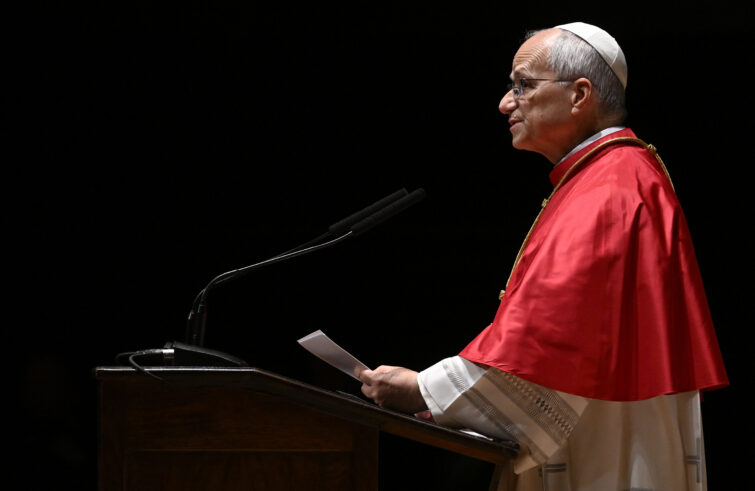
(Photo Siciliani-Gennari/SIR)
In the same speech the Pope asked that private initiative be encouraged and that the benefits of growth reach those in difficulty. Under what conditions can this happen?
There are different forms of private initiative. There are those who pursue their own advantage, leaving the crumbs to others, like the rich man with Lazarus. History shows that wealth concentrated in one part of the population does not automatically translate into benefits for the rest of society. The Pope's words must be read within the tradition of the Church's social doctrine, from Centesimus Annus to Fratelli Tutti, in light of the universal destination of goods. From this perspective the State has a precise role. Without a strong public presence, private initiative can lead to the formation of monopolies.
Leo XIV identified training, the university, and research as areas to invest in so that young people can carry out their projects in Argentina. This is also an issue for Italy's Mezzogiorno. What makes the choice to stay possible?
Young people have the right to go wherever they wish. If we want them to stay, we must offer them opportunities that make that choice worthwhile. Here governments have a great deal to do, from training and study through to work. A young person must be able to see a future even in their own country. And if they decide to leave, they are right to seek elsewhere the opportunities they lack. The homeland of every young person is the whole world.

In Pucallpa the Pope denounced the logics of exploitation that threaten the Amazon and its peoples. Who should decide how to use the forest's resources and how to share out the benefits?
A forest like the Amazon is a global common good. Responsibility for these choices rests first of all with politics, because in a democracy decisions can mature through pluralist debate. The involvement of the countries across which the forest extends is needed, along with a role for the United Nations. The future well-being of humanity is at stake. Market interests tend to look to the short term, whereas politics should take on the responsibility of looking also to our grandchildren and great-grandchildren.
Speaking of artificial intelligence, the Pope recalled the responsibility of those who decide how to use it. How can productivity gains be distributed so that workers also benefit?
We need a new great social pact. Even in technologically advanced economies, work alone will no longer be enough to guarantee a fair distribution of resources. With artificial intelligence and robotics we will have to decide to whom the wealth produced by machines goes. If this choice remains in the hands of individual firms, inequalities risk exploding. Today artificial intelligence is held mainly by private actors, with a weak public presence both in ownership and in management. For this reason the pact calls politics into play. I have a very high opinion of the market, provided it remains the penultimate word on the world.